Tuesday, 13 January 2015

17 Alternative Gerrard Memories

Anyone a bit sick of the Gerrard stuff yet? Nope, me neither. Like most who work in sport, I get through a phenomenal amount of Sky Sports News each day and I'm still not yet irritated by loop after loop of Olympiakos, Istanbul or the absurd banana strike against Middlesbrough. However, if you are finding it all a bit tedious - here are 17 (one from each season) alternative memories of the greatest Red I ever did see:

1998-99 - The Subbed-Sub

Steven Gerrard holds plenty of records, but has anyone checked whether he boasts the quickest voluntarily subbed-sub in history? He replaced an injured Steve McManaman 25 minutes into another one of those 90s thrillers against Newcastle, but despite a one-man advantage (Didi was sent off for the Barcodes), the Reds fell behind. Gerrard was hooked at half time for fellow academy graduate Davey Thompson, and although the Toon would score again just after the break, the Kop sucked in four goals and the three points.

1999-00 - A Highbury Cameo

A 1-0 win at Highbury in 2000 provided the perfect cameo of the early Steven Gerrard: In 33 minutes, a sumptuous match-winning pass for Titi Camara, a heart-stopping, out-of-nowhere, goal-saving tackle at the feet of Freddie Ljungberg, before back problems caused by growing issues forced him out the game. Mercifully, his fitness problems would soon subside for a decade.

2000-01 - Bossing Vieira

Gerrard often cities Vieria as an idol and a player who frightened him in his early years, referring specifically to the runaround the Frenchman gave him in Cardiff before Michael Owen committed daylight robbery on the way to the 2001 Treble. Six months previous, a match took place that rarely gets mentioned by Liverpool's occasionally insecure captain. A 4-0 win against a side as fine as Arsene Wenger's turn-of-the-century Gunners is not recalled as often as it should. Gerrard scored a beautifully controlled volley early on, and proceeded to give the Arsenal skipper all the ammunition for revenge later in the season with the sort of stunning all-action performance that, even though it was for the best, I missed under Benitez.


2001-02 - The most underrated goal of all time

I implore you to watch Danny Murphy's winning goal at Old Trafford in 2002. We should always saviour long-range screamers, spectacular volleys and flowing counter attacks - but lets face it, they happen somewhere in England every weekend. This is why I love Murphy's goal. Its utter uniqueness. Gerrard carves out a pass that is never on, one which is worth a thousand missed Hollywood-balls, and Murphy delivers a cracking flick over Barthez from 10 yards. And you thought Sturridge's lob was audacious? As Martin Tyler said at the time - "the pass was so good, it told Murphy how to finish it." Quite right.

2002-03 - Hauled off for Diao

A rare negative memory here - and its a real downer. Gerrard's Liverpool career entered a bizarre crossroads in 2002 and things rather bottomed out in Basel. A must-win Champions League match and the number 17 was being replaced at half time by that go-to man, Salif Diao. The Reds came from 3-0 down to draw 3-3 (one for the stattos - we are just as good without Stevie, right?) - though it wasn't enough to qualify for the next stage.

2003-04 - Captain Fantastic

Ah, the rarely seen Gerrard left-footed belter. Steven is by no-means a one-footed player, and indeed is a fine finisher inside the box with his weaker peg, but he rarely tries one from distance on his left side. So this low, skidding volley against Levski Sofia in 2004, one of his first goals as captain, is a particular favourite. I also love the celebration with Houllier, a show of support for his mentor who was soon to be on his way out. He was becoming a leader.

2004-05 - Not The Biggest Derby Ever

The 2005 Merseyside Derby at Anfield was billed as the biggest of the Premier League era, as a playoff for the Champions League. As is the case when the stakes are raised in a derby - Liverpool won. But it turned out not to matter as the Blues finished above us anyway, and then Istanbul went and overshadowed everything ever, and we've all gone and forgotten it. Gerrard scored a smart free kick, shaping to whack it and passing it neatly inside the post before Garcia made it 2-0. The Reds then lost three players to injury in the first half, Milan Baros to a red card in the second,  and with Luis Garcia hobbling on one leg for most of the second half during which Tim Cahill halved the deficit. The captain pulled us through, and instigated a post-match huddle. Sounds familiar.


2005-06 - Total Network Solutions

Gerrard's first game after turning down Chelsea, and the first of a Footballer of the Year campaign that would end with that West Ham goal. It started with a shy and embarrassed-looking Steven (he graduated from Stevie to Steven that season) scoring a hatrick in a Champions League qualifier against TNS, complete with Kop left-footer from outside the box, and not a single smile all night. He felt he owed us something. By the end of 05-06, we owed him everything. He'd always have us.

2006-07 - Forgotten genius

When you've scored over 150 goals, at least one in every major cup final, plenty of pile-drivers, last-gasp winners and big-game moments, its easy to forget those random moments of early-kick-off genius that make everything okay. A lunch-time cruise at The Valley on a chilly December Saturday against a woeful Charlton, two goals and three points already in the bag. No atmosphere. Just get it done and get home. And then we all had something to remember. Gerrard latches onto Crouch's knockdown and assessed the options, before a nifty shift of feet and deftly despatching the ball into the top corner, with a hybrid curl-chip strike. Delightful.

2007-08 - Headers

It is said of a lot of great players who score a lot of great goals, that heading is their weakness. It was often said of Raul, but if you actually go back and watch his goals, he'll score some splendid headers of all different kinds; thumpers, glancers, poached flickers and so on. He was better at heading than 90% of other footballers, but this gets missed because he was such a slick finisher with his feet. Gerrard is similar. Besiktas away in 2008 turned out to be in vain, but its a ridiculous diving header in an attempt to rescue a draw. Have a look.

2008-09 - Atletico Salvo

Liverpool were so good in 08-09 that Gerrard wasn't too often forced into the one-man-shows that Rafa Benitez felt so conflicted by. However, at home to Atletico Madrid he had to take matters into his own hands as a turgid Liverpool were heading for defeat. Neither team nor skipper could manufacture a shooting position on the edge of the box and the seconds were ticking down. So Stevie won the most absurdly-won penalty the Kop has seen - and Steve Heighway got a few dodgy ones in the 70s. Its almost beyond description. There was no danger. Repeat, there was no danger.  A ball harmlessly dropping from the sky in the most harmless spot in one corner of the box, and Gerrard saw his final opportunity. Sheer determination to get to the ball first and induce contact in the area. He sticks the pen away with ease and the Reds all but qualify. Nice.


2009-10 - Showboating against Stoke

Not one for a stepover - but Gerrard does occasionally frequent the showboat. A fabulous half-turn on the half-volley leads to Dirk Kurt scoring a third in a 4-0 win. Worth watching.

2010-11 - Missing on purpose

Gerrard became a very reliable penalty taker as the years went by, but his worst ever spotkick came rather inexplicably at Ewood Park in 2010, and it was quickly followed by Roy Hodgson's P45. He didn't though, did he?

2011-12 - Back from injury

Off the bench at home to Newcastle to score a decent solo goal and secure a 3-1 win. Not the type of goal that will make many Gerrard compilations due to the lack of drama and dodgy goalkeeping, but memorable for the celebration of a man who'd been struggling with groin injuries that he'd later reveal would nearly end his career and cause him ripping self-doubt.

2012-13 - Favourite Opposition

All players have them, and Gerrard loved to rub it into the Holte End. He has scored 13 goals against Aston Villa in his career, including this second half penalty that earned the Reds three points in the spring of 2013. He followed it with a headed clearance off the line to make sure. Not bad for a player who was by-now being written off by even plenty of his own apparent fans.

2013-14 - The Greatest Goal That Never Was

Oh, how I wish this one had gone in. This would have been the goal to end all goals. What was he even thinking in trying it? Luis Suarez had scored four corkers, but Gerrard almost stole a share of the headlines with a 270-degree twist and left-footed flick which sent John Ruddy to Hong Kong as the ball headed for California, and agonisingly clipped off the post. Its the first time that Goal of the Season should've gone to a miss.

2014-15 - Facing the demons

Gerrard could've packed football in after the World Cup in Brazil. Its hard to think of a footballer who shouldered so much responsibility and suffered so much personal sporting heartbreak in the spring and summer of 2014. Three games into the new season and Penaltypool win their first spot kick, and it would've been easy for Gerrard to hide. He could've passed it to Balotelli, hungry for his first goal and with a near-perfect penalty record. He's facing the league's second-best shot-stopper. He's been the laughing stock of the meme-go-round since the slip and the last thing he needed was twelve yards and a zoomed camera. There are so many reasons to doubt, and so many reasons to allow self-pity to take over. He looks concerned. Doesn't he always? Gerrard puts it away and blows a kiss to the away end, with a brief fist pump that says, "I'm here, and I'm still trying for you." 

Top, top man.


Friday, 2 January 2015

Dissecting the Opposition's Gerrard Obsession

After sixteen years and almost 700 games, Steven Gerrard knows the script. If you aren't familiar, take the time to peruse your fan song-sheet on the back of your seat and locate track two, just after the compulsory post kick-off rendition of "your support is fucking shit." Welcome to your average English football stadium - you'll find more original versions at a Westlife concert.


On this occasion, a match at Anfield between Liverpool and those bitter rivals from...erm...Swansea City, he wasn't even playing. Yet while going through first-half stretching exercises as a substitute, Gerrard generously offered a smile of acknowledgement to those who'd spent upwards of a ton to travel to Merseyside on a chilly post-Christmas night, to sing about him slipping over in a football match that had absolutely no impact on them whatsoever.

Gerrard is used to the 'que sera sera' adaptations by strangers supporting stranger clubs, and not least because its the tune of one our own songs for the captain. Whether its about his passing, his better than Frank Lampard-ness, his wife, children, birthplace or falling over, and whether he or Liverpool are even playing that day, you will hear it being sung at some point on Match of the Day each Saturday.

The nature of the opposition's obsession with Gerrard is a curiously negative one. He's been a great player, even a captain of England and a relatively inoffensive one. There's been the odd transgression, but he's never bitten an opponent or fly-kicked a paying supporter in the face, nor he is he a particularly serial simulator, adultorer, or one to tediously feign an injury.

His brilliance with a football means he'll score against you quite a lot, although I wasn't aware that this alone was something to hate so enduringly. Furthermore, unless you dish out some severe stick to him first and you happen to be one of Liverpool's historical rivals (sorry, Swansea), then despite a thirty-yard thunderbolt in the last minute you're unlikely to face an ear-cupping or a 'ssshhhh.' He'll be too busy running to his own adoring supporters. The way it should be

So why the negative obsession? Why will 2nd January 2015 go down as the best day to be a shareholder in the meme business, in stark contrast to the week of deserved eulogies we witnessed for Thierry Henry recently?

There is this:

Liverpool have rarely been very good of late. Since 1990, in fact. You've probably noticed. Since Liverpool were last kings of English football, sixteen different teams have finished above us. Even now the top division has split into tightly concealed mini-leagues, entry to which clubs risk their future existence and prioritise above winning cups, Newcastle (where Gerrard is routinely booed) have finished above LFC in a quarter of Premier League seasons. Last term's second place halted a run of four consecutive summers looking up at Spurs. QPR, Sheffield Wednesday, West Ham - even Everton have managed it three times.

There are plenty of teams who feel, and perhaps rightly, that they've been toe-to-toe with Liverpool for long enough to demand some respect, a share of column inches and some complimentary midfielder comparisons. Some have got the better of us enough times to warrant consideration as our equals.

But then, there is this:

When a team loses fourteen league games in a season, yet comes from 0-3 down to snatch the most magical of European Cup victories - WHEN DJIMI TRAORE TOOK ON PAOLO MALDINI AND WON - it is Liverpool.

When a team is outplayed in the FA Cup Final and throws on Jan Krompamp as its final roll of the dice, but still comes from two goals down to win on penalties - it is Liverpool.

When a team not good enough to challenge for their own league title wins three cup competitions in the same season, something you've never seen before and likely won't again - it is Liverpool.

When that mediocre bunch finishes seventh, then wallops top-of-the-league FIVE-ONE, scores 100 goals, wins 11 straight through the business end of the season to go within a whisker of being the first team in 30 years to win the league after finishing outside the top-six - it is, somehow, Liverpool.

It can only be Liverpool - and it can only be Steven Gerrard.


Even Arsenal, despite two league and cup doubles and an unbeaten (unbeaten!) season, have been unable to shake us off, and have taken an increasing and unreciprocated dislike to us and Gerrard. Seeing Igor Biscan's Liverpool finish 25 points below but win the Champions League they've had 17 consecutive pops at, as our hero remains loyal while theirs routinely join Barcelona or one of the Manchester clubs, has taken its toll.

Steven Gerrard has allowed us to see glories that fans of so many other teams feel they are entitled to, and cannot comprehend how Liverpool have pulled it off again.

However, for two weeks in the spring of 2014, something bizarre happened; Liverpool and Gerrard very briefly ceased to be the laughing stock of English football.

The image of the number 8 urging his teammates in an impromptu huddle to "go again" at Norwich after a sanity-sapping win over Man City, is now the backdrop to football's recycled joke circuit. However, at that precise moment, fans all over the country (with the obvious exceptions) wanted that to be their captain, doing that on their pitch.  For a fortnight, Gerrard could've walked into any stadium in the country to a standing ovation. He was English football's saviour, its darling, and we shared him with you for a touch over 300 hours.


When the final whistle blew against City, Gerrard abandoned football's PR rulebook and became exactly how we, as fans, envisage we would behave on the pitch at that moment. Sobbing into his red sleeve, he put his reputation on the line with the on-camera rallying cry. The official message may be one game at a time, that the title wasn't a consideration for a team that failed to qualify for Europe 11 months earlier - but with 44,000 other fans going bananas around him, Gerrard only knew one way.

He represented everything that fans yearn to see each week, even more than the goals and the performances, the Istanbul 05s and Cardiff 06s; turning down wealthier contracts from better teams to withstand wretched owners, bitter infighting, biting, beach balls, outrageous signings and defeats ranging from the agonising to embarrassing and beyond. All this, for the love and honour of playing for the team he supported as a boy.

In the next 13 days, my phone and social media were awash with messages of support for the Reds, and in particular admissions that Steven Gerrard deserved this league title. They hoped we won it for him. Unfortunately cruel fate determined it wasn't to be, and never would be, and most of those supporters quickly reverted to type.

Not winning the league was a low point for Gerrard. For all of us. But at this juncture, his leaving of Liverpool, it only adds to his legend. The slip against Chelsea can happen to anyone, anywhere. Just ask John Terry. But the 13 goals and 13 assists from a defensive midfield position that preceded the cruel misfortune, that is a different story.

Liverpool thrilled us during 13-14; Suarez' pre-Christmas form was absurd, Sturridge consistently found the net with Fowleresque hunger and precision, and Sterling came of age - but it was Gerrard who dared to take Liverpool over the top. He knew time was running out for him. He knew City and Chelsea would be back to spend bigger still, United too, and that Suarez would likely be off to Spain and that we were punching gloriously above our weight all year. It was now or never. The odds were stacked against and the pain of getting close but missing out would be too much to bear - but he took us all there anyway. One last time. Craven Cottage, Upton Park, Old Trafford - penalties despatched to keep the dream on life support - then Sunderland, City, Norwich, carrying the team on his back over one marathon finishing line and onto the next.


Even in the darkest moments when the salt was being rubbed into the wounds, he was lifting a dejected Luis Suarez onto his feet at Selhurst Park rather than feeling sorry for himself. What a captain. What a privilege to watch him living our dreams and helping us get through the nightmares.

Finally, before I am battered with questions about seeing "Slippy G winning the league," remember that he is not finished just yet. If he does, as most suspect, join the MLS, hopefully he can win five successive league titles and finally be considered on a par with John O'Shea before he hits 40. Then he will command some modicum of begrudging respect from those who have written the criteria on judging greatness.

But if you are unable to muster any admiration, then I can only sympathise. You've missed out on something really special, something that will become increasingly rare in football, to the point you may not ever see it again.

As he would say with a squeak, sniffle and a shrug - "all the best."


Friday, 11 April 2014

Not Another Jordan Henderson Article

We told you so.

One of the many pleasures of being a Liverpool fan through this exceptional season has been the amount we've been able to slam back down the throats of others. We told you Daniel Sturridge wasn't arrogant, merely better at football than almost everyone else. We told you that Steven Gerrard wasn't finished. And we told you that Jordan Henderson, gait and all, could be an excellent midfield player in his own right.

That last one has even started to wear a bit thin. I can't tire of seeing Sturridge skin an opponent and plonk a Fowleresque finish, or Gerrard wheel away after another colossal display of nerve - but one more minute of Jamie Redknapp 'analysis' of how Jordan Henderson isn't actually shite, and the pressure of this title race might finally finish me off.

My feelings over this Hendo-fest are much like my feelings over the general warmth of the public towards our unexpected title charge and how we've become the people's pick for the title - kindly get to fuck. This is our party, and we didn't invite you. We've been the laughing stock of English football for a number of years, and much of it was even justified - but now its our time, and you don't get to switch your allegiance.

In any case, this Henderson palaver was all quite foreseeable. Gifted, but grossly overhyped when he broke through at Sunderland, particularly when managing a whopping 3 goals in a breakthrough season, Henderson was unreasonably thrust into the spotlight as the press clamoured for England's next midfield after the shambles of South Africa. The comparisons to the incomparable Lampard and Gerrard were inevitably laid on with a trowel, and just as quickly vanished once he'd earned his first hastily-awarded cap alongside Jay Bothroyd in front of a bored, baying Wembley crowd against France.

All he needed to secure his unwarranted downfall was to join Liverpool for an undisclosed (varying between £14m and £20m depending on who wrote the article) fee that summer. Merely holding up a scarf at Melwood was enough to make you a write-off at that time.

Three years on, and there has been a satisfyingly gradual development about Henderson, from the raw, energetic, yet intriguingly tidy promise at Sunderland, through encouraging yet erratic progression under Dalglish, to the more polished, aware and astute operator he is under Rodgers. Lo and behold, he was never the next Patrick Vieria nor the new Salif Diao. Though this is Premier League football in the 21st century; Hyperbole HD 24/7.

By the way, its not just Henderson's detractors that got it all wrong. Since he swerved Rodgers' fire-sale on arrival, plenty of his biggest fans drew on a particularly peculiar theme that rears its head every so often amongst Liverpool's fan base; Its all the fault of our one of our greatest ever players.

You see, Steven Gerrard is the problem. When he's not there, Henderson has the freedom to express himself, without the intense stare of the captain burning a hole in his jersey. Gerrard is tactically sporadic, too forceful, too fired-up, too passionate and...well...too good. The same excuse was rolled out for Xabi Alonso during the mediocre middle-three of his five year spell at Anfield, and for Lucas Leiva too when the apparently free-scoring box-to-box Brazilian suffered in his first two years at the club. Joe Allen is the latest victim.

Thankfully, Brendan Rodgers has coaxed this nasty habit out of his number 14, busting this absurd myth that has thwarted other talented players at Liverpool and elsewhere. If a player is suffering in the shadow of another, its simply the former's flaw to overcome. They used to say the same about Wayne Rooney when Cristiano Ronaldo was hogging the limelight at Old Trafford. Ronaldo is certainly a better footballer, but the wider gulf is in their respective mentalities, and Ronaldo's departure from United and subsequent year-on-year improvement has only further emphasised it.

The inferiority complex that reduced Henderson to a rabbit in the headlights when the stage was set for him against Cardiff at Wembley in 2011, has been consigned to the history books of a largely forgettable period of LFC history. This season, he reduced Ozil to ashes in the massacre of Arsenal, twice towered above the Tottenham side that was supposed to keep us out of the top four, let alone top the pile, and in the most horrendously ill-anticipated match I've ever experienced, he was monstrous in Manchester. The perfect foil for his skipper.

Such was the level of his display at Old Trafford, Alex Ferguson should be forced to enter the prawn sandwich seats of his former stomping ground through the Jordan Henderson Gaits for all eternity.

Liverpool are poetry in motion, and Jordan Henderson fills every unforgiving minute with sixty seconds' distance run. And what is more - we bloody well told you so, lads.


Wednesday, 14 August 2013

Dalglish, Benitez & Rodgers: Why FSG Were Correct To Hire Their Own Man

There has been no other Liverpool manager I've wanted to succeed more than Kenny Dalglish, when he returned to rescue us from the desperately dark but mercifully short reign of Roy Hodgson. I'd grown up on the stories of King Kenny, for so many the Reds' greatest player, a three-time league championship winner as manager, and the man who sacrificed his own health, and ultimately the job he loved, for the people of Liverpool in the aftermath of Hillsborough. He was back to finish the job he'd started and left in 1991, and what a story it would've been if he could've taken us all the way back to the top.

Likewise, there are few who will have as much admiration and respect as I do for Rafael Benitez, both as a coach and as a person. Istanbul rightly makes him a legend alone, after which he developed the best Liverpool team since Kenny's last title winners, gave us another European final and took us so close to the promised land of number 19. His departure under the cloud of Hicks and Gillett's ownership was one of the lowest points of a low period in the club's history.

There are plenty of fans who will share one or both of these opinions with me, but this is not a piece debating whether or not either man should've been removed from their posts at Anfield in the first place. The problem is so many chose to use them as sticks to beat Brendan Rodgers and FSG with, ignoring any progress on or off the pitch, casting aside results and twisting any interpretation of events to fit their agenda - that one of the aforementioned legends should be manager today, and that the club is lost without them. They also have one or two high profile sports journalists whipping them into a frenzy over the subject after every draw or defeat, every player bought or sold and every trophy missed.

I, for one, completely understand why FSG parted company with Kenny Dalglish, and likewise, why they did not approach Rafael Benitez to replace him, and I'd go as far to say I admire them for the brave decisions they took in the summer of 2012. At worst, this makes me a bad wool, which I can handle. But it has nothing to do with the coaching abilities of either, nor does it affect the place these two men have in this club's history, or suggest that I was happy to see either of them leave initially.

This is the reality of the situation that faced FSG at the end of the 2011-2012 season. Kenny Dalglish was never meant to be Liverpool's permanent long-term manager after he arrived to steady the ship that Hicks, Gillett, Purslow and Hodgson had seemed intent on consigning to its final chapter. The remarkable turnaround during the latter half of the 11-12 campaign led to Kenny rightly and respectfully being offered a relatively short extension on his temporary contract, and he would become a victim of his own success when league form took a severe nosedive during a campaign which would do more damage to Liverpool's image than any other in recent memory.

But why not, given the two cup final appearances, give him one more season? And if we absolutely have to turn our back on a legend, why not approach another, and a proven, modern manager to boot, to replace him?

FSG may not be experienced football men, but if their Boston Red Sox tenure hadn't already given them a rounded understanding of the fiercely political nature of top professional sports clubs, then the sales process of LFC alone would've been a severe eye-opener. They had been right to extend Kenny's stay given the impact he'd had on return, but they were now faced with an almost impossible decision with regards who they actually envisaged as the right man to take this club forward for the next decade and more.

Brendan Rodgers, Andre Villas-Boas or Roberto Martinez would've been FSG men, managers they were responsible for hiring, overseeing, advising and perhaps firing. Kenny Dalglish was our man. Rafael Benitez too, was our man. Not just in the sense that they were our first and second choice managers, but they were also kindred spirits amongst the Kop, club legends and idols, more than just trophy winners and technical achievers. They are not exempt from balanced criticism, but they are rightly untouchable in status.

To employ either, is for FSG to place a divide up between themselves and us fans before a ball is kicked, and we would be keeping the manager for ourselves and our battles. Rafael Benitez had already been a key figure in our protests and forcing-out of Hicks & Gillett - while the complexities of the financial situation of the club didn't always translate to the man in the stand, their treatment of a European Cup winning manager did, and as such he was the obvious focal point. Having already decided, painstakingly, that Kenny Dalglish was never going to be the long-term manager within an FSG structure, Rafael Benitez was never going to stand a chance in the interview process. This was going to be FSG's selection, and their responsibility, who would be handed over to supporters for them to judge for themselves, rather than a man the owners must disproportionately raise their game for.

It was a shame, but it was understandable, and my personal feeling is that it could pay dividends in the future given the gradual progress we are seeing under Rodgers, which we can debate daily, unclouded by our affection for Dalglish and Benitez. My hope and belief is that Kenny will return to the club in an ambassadorial role one day, as and when the club is in a period of success so as not to spark rumours of him being groomed for another caretaker role. Rafa too, may one day be back at Anfield in some role or other, but for now I wish him all the best in his exciting job in Naples.

As I wrote a year ago, Rodgers made the perfect start to his Liverpool career by accepting Anfield's friendly ghosts, including Dalglish and Benitez, rather than distancing himself from them in the way that Hodgson did. It was a moment that made me feel the right decision had been made, despite a summer of anguish watching club legends pass us by.


Wednesday, 7 August 2013

My First Footballing Love

There are times when you just have to take the plunge, because life is simply too short. Forget the risks, ignore the stacked odds against satisfaction and success, and disregard every sensible reason to leave this nagging, deep-lying desire alone. Some plump for the mundane, such as running a marathon or climbing Everest, while others quit their job to start a business or move abroad. Then, there are a tragic select few who chose to write about their hero.


First-Love Footballers


The first cut is the deepest. In his book 'Changing Relationships', Dr Malcolm Byrnin says that the secret to happiness in a relationship is to 'skip the first relationship'. In an ideal world, you would miss out childhood and youth altogether and wake up in your second relationship, because the first love ruins it for all the others, yet you must never, under any circumstances, go back.

When it comes to our footballing heroes, this issue is magnified by the unique nature of the emotional attachment, in that puberty isn't a pre-requisite. It is the one phase of life that isn't age-sensitive; more intense than a teenage crush and resistant to being rescued by the more pragmatic approach of adulthood. As such, it is the most enduring of admirations. All the other childhood fixations - a security blanket, a particular favourite toy or a cartoon movie - all fizzle out, only to be revisited in later life on nostalgic whims, promptly discarded when inevitably the novelty wears thin.

The attachment that makes you compelled to wear a daft plaster on your nose during your U11s Sunday league matches is the same that makes you forget it's your anniversary when you proclaim to your partner in the moment your hero re-signs for Liverpool that it's 'The Greatest Day of My Life'.


On January 27, 2006 I got the call.


That phrase makes it sound like I'd just been called up to my first senior England squad, and I imagine the level of euphoria is very similar. Robbie Fowler's return felt like one of those joyous days when you realise there are certain elements of supporting a football team that are far more important than the football itself.


To many on the outside, Fowler was merely a remarkably gifted striker, often referred to as the most natural finisher of his generation. But to some of us, he was untouchable. He was, and still is, 'God', and no one, not even John Barnes or Ian Rush before nor Steven Gerrard or Luis Suarez since, is quite capable of filling that void. While the pain of cup exits or missed opportunities in the title race can be soothed by the release of the next fixture list or the arrival of a new signing, once your first hero has been moved on, a fan's journey moves into a new era. For many of us, it was Liverpool AD between December 2001 and that magnificently unexpected day in January 2006.


This was because, for the boys living and breathing football 24/7, nose-plasters and all, he was the local lad who banged the goals in every week, living the dream we all dreamt in the playground. Meanwhile, to those who had stood on the Kop for decades prior, Fowler was a throwback to the original goal machines, drawing comparisons with the likes of Rush and Jimmy Greaves. He wasn't an athlete-cum-footballer, or a player moulded and manufactured out of sports science, but a pure, authentic marksman. An instinctive game defined by an acute sense of space in and around the box, and an unparalleled ability to find the one square-inch of net that a 'keeper couldn't reach, from any distance or angle, with any part of his body. When the ball fell to Fowler in the box, even if it was his only chance in 90 minutes, you always got that split-second rush of blood in anticipation of the net bulging, which for most other players, would take a gaping goal and an already sprawled 'keeper.


Furthermore, after each and every one of his 259 career goals, there was never a pout or posture, no 'ssshhh' or cupped ear to the public. Only outstretched arms and a beaming smile accompanied every goal. The simplicity and normality with which he approached and played the game, made him someone that fans of any age could relate to.

But perhaps most pertinently of all, to many thousands of Liverpool's support, Fowler was the shining light that helped guide the club as it sought to emerge from its darkest hour. Four years on from Hillsborough, both club and city were still coming to terms with the impacts of the disaster and the ongoing injustices and cover-ups that, as it would turn out, were still only being concocted. The on-pitch fortunes of Liverpool FC were offering little solace, as football had so often done for the masses in previous decades. Kenny Dalglish had stepped down, a golden era of players retired around him, and Graeme Souness hadn't managed to pull off the impossible job. Liverpool were distinctly mediocre in mid-table, out of the European competitions that defined us in the previous three decades, and playing in front of dwindling crowds while Manchester United began building their dynasty.

Dwindling crowds - like the 12,541 who turned up at Anfield to watch Liverpool play Fulham in the second leg of a League Cup second round tie in 1993. Two weeks earlier, Fowler had made his first-team debut, scored once and had a hand in two others as the Reds won 3-1 at Craven Cottage. On this occasion, he scored five; three with the left, one with the right, and one thumping diving header. He was just 18 years of age. It's impossible to imagine the extent of the country's reaction if an English teenager repeated the trick in 2013 and beyond, and we'll probably never know. This wouldn't be the last time Robbie proved to be one-of-a-kind.

English football would soon enter a period of seismic shift from the classic to the commercial, with Fowler bridging the old and new eras. Emphasising the early impacts of the newly formed Premier League, he was the first teenage British footballer to sign a £1millon contract and he became a global superstar overnight. He'd soon be playing in front of crowds in excess of 40,000 at Anfield every other week, regardless of the opposition. Yet as the years went by, even when a 'broken toe' became a 'fractured metatarsal,' Fowler never changed.


A year after the fiver past poor Jim Stannard, the Toxteth Terror produced another unprecedented moment. Somewhere, there is a family of people who, on August 28, 1994 switched over for the weather forecast or to catch an over of Dominic Cork during England's one-day international with South Africa, and missed the lot. Fowler scored a hat-trick in four minutes and 33 seconds, ghosting through the meanest, most experienced defence in the country, and plonking the ball three times past Arsenal and England's No.1, David Seaman.

Others would've succumbed to the adrenaline, or the law of averages, when presented with a half-chance less than a minute after opening the scoring during the first home game of the season. But Fowler - bang, through Dixon's legs, bang, bang - three times he found the handkerchief-sized patch of net just inside the far post, something he could do like no other of his generation.

There were countless other days that made us delighted he was ours. Only Robbie could've dominated the headlines the day after Eric Cantona made his comeback from a nine-month ban, when he scored two stunning goals past Peter Schmeichel in 1995. Only Roger Hunt had reached 100 goals faster for the club, when he put four past Middlesborough a year later, in his 165th senior game.

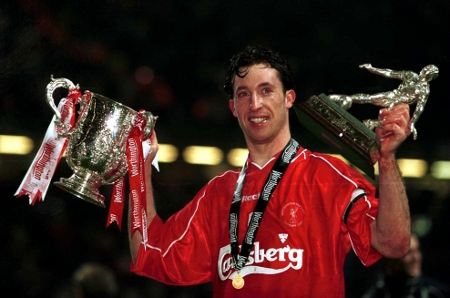
In 2001, he was skipper and man-of-the-match after scoring a spectacular dipping volley and clipping in a cheeky shootout spot-kick in the League Cup final win over Birmingham City. He would then lead the Reds to an unprecedented cup treble, scoring as a substitute in the 5-4 Uefa Cup final win over Alaves. On the final day of an incredible season, he struck perhaps the two most important goals in his career, in a 4-0 win away at Charlton, which sent the Reds back to the European Cup for the first time for over a decade.


More Than Just Goals


However, for all the goal-scoring exploits, it was always what Fowler represented beyond the statistical that mattered most to Liverpool supporters. He once even tried to sacrifice a scoring chance, in a vital top-of-the-table clash against his favourite bunnies, Arsenal, at Highbury. His attempts to convince Gerald Ashby to reverse his penalty decision when he hurdled Seaman's lunge and fell to his knees are unlikely to be seen again in a match of that magnitude, if at all.

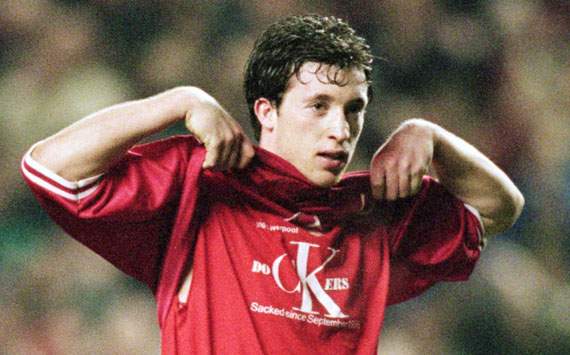
But the gesture which best sums up his relationship with Liverpool supporters, came during a Cup Winners' Cup tie against the Norwegians of Brann Bergen in 1997. I'm not talking about his volley in the first leg, which followed a ridiculous piece of skill that has to be YouTubed to be believed. In the second leg, he struck with typical aplomb at the Kop end in the second half, his second of the match, and revealed a t-shirt pledging support for Liverpool's sacked dockers that would earn him a UEFA fine, but also the admiration of the city, even the reluctant blue half.


This is what separates true cult heroes like Fowler from the rest. Fans could watch him from the stands or on TV, and no matter how much money he earned - the famous property portfolio, the cars and the worldwide fame - when he took to the pitch, he simply seemed like the one of us that got lucky, and nothing more. That's why, for a few brief moments in 2006, when a bleary-eyed Robbie stumbled through a press conference, referring to 'Mr Parry' and 'Mr Benitez,' we could watch a footballer talking about a 'dream come true' and genuinely believe every word.


Breathless


For all of the above, we all have our own distinctive favourite moments.

My first visit to Anfield, in April 1997, would effectively end Liverpool's hopes of a title challenge, after goals from Coventry City's Noel Whelan and Dion Dublin inflicted a painful late defeat. But I had the most thrilling experience.

High in the Kop, when Robbie latched onto John Barnes' lofted pass, we all rose in unison. As he unleashed a right-footed volley towards the roof of the net, I strained to see over the crowds and could see the ball dipping under the bar, yet had to react on a split-second delay, requiring the roar of those around me to confirm it hit the net. I remember turning to my Dad and trying to bellow the words 'What a goal!'. I didn't make it to the end of the short sentence, and had to take a deep breath before repeating myself, again at the top of my voice as his name rang out around us. I can look back now and appreciate that when people talk about breathtaking experiences, it doesn't have to be figurative.


Closure


Almost 10 years to the day since Fowler left me breathless, I watched him miss an absolute sitter of an open goal from six yards against Fulham at Craven Cottage, on his penultimate Liverpool appearance, at the same ground he opened his account as an 18-year old. But thankfully, now as a fully grown, cynical adult football supporter, I had savoured every single minute of his second coming, and was fully prepared for the second closing.

In his second spell, Fowler scored 10 goals, including his first and only two in the Champions League, and surpassed Dalglish in the scorers' list for good measure. His contribution in the final months of the 05-06 season allowed Benitez to rotate his forwards, securing third place in the league and an FA Cup win in Cardiff. After limited but always whole-hearted contributions the following season, another third place finish and a second European Cup final for the club in three years, he was given the send-off against Charlton that he missed out on in 2001, and was replaced by the phenomenal Fernando Torres that summer. Closure.

Increasingly, outside of his following, Fowler's ability and achievements will be lost in the swamp of obsession over what constitutes 'greatness', where people are more concerned with establishing the criteria of a 'great' player rather than allowing fans to follow their hearts. Don't succumb to those who were more concerned with whether London 2012 was the best Olympics of all time, but just savour those unique memories and the feelings they gave you.


Robbie Fowler may not have been the best, but he was definitely my greatest.

Tuesday, 6 August 2013

Credit Boss For Steady Rise

It's the first pre-season friendly of the summer; 56 days of traipsing alone through goalpost-ridden parks with only a fold-out fixture list for shelter from the drizzle, and 56 nights of falling asleep to the season review DVD, are gone in an instant, replaced by new rays of hope and optimism in the Preston sunshine.


Midway through the second half, one of the most talented and exhilarating young footballers in the country times a run to perfection, breezes round the goalkeeper and nonchalantly tucks the ball home as if it was, and will be, an everyday occurrence.


Raheem Sterling is still a teenager, tremendously gifted, and Liverpool Football Club's for the long-term after signing a new contract last December. He's back with renewed hunger and a clean bill of health after an extended rest from his induction to the physical and psychological rigours of Barclays Premier League football. He is ready.


Permission to get preposterously and disproportionately over-excited? It's a bit late for that. Marquee signings provide a buzz, but there is an additional dose of pride when a special talent makes the breakthrough from the Academy to Melwood. We don't just marvel at his footballing promise, we deeply root for the lad too, which makes every progression a thrill.


While Sterling has been warming up for the new campaign with a goal at Preston, and another in Jakarta, most eyes seems to have been on another young English talent, Wilfried Zaha, who by all accounts has hit the ground running in pre-season for Manchester United.


Zaha's decision to represent England last year when he lined up alongside Sterling for their debuts, coupled with a £15 million move to the champions in January, came with a guarantee of unrivalled attention during what could be a pivotal season for his new club.


He may not have played a Premier League match in his life, but the comparisons will be to both the league and United's past and present elite, and conclusions relating to the size of his fee and the extent of the hype will be drawn and re-drawn each week.


Meanwhile, Sterling was not even the most talked-about young Englishman on the pitch at Preston, with Jordon Ibe rightly taking some plaudits, building on his strong showing against QPR in May with a crisp strike in the first half, and continuing to impress Reds fans thereafter during the overseas tour. The future looks bright.


However, the country-wide reaction, or lack of, to Sterling's latest displays of speed and skill matched the pleasantly serene nature of Liverpool's start to pre-season, when the goals flowed with ease at Deepdale despite inevitable rust, a few new faces and the absence of some experienced stars.


This is all no accident, and Brendan Rodgers must take a wealth of credit. It is easy to talk vaguely about good man-managers, or praise a coach for privately 'putting his arm round' a young player, but Rodgers made a series of brave calls last season regarding Sterling's selection, and all without the choice of disguising them from the closely watching media and fans.


These didn't just preserve Sterling's physical and mental wellbeing, but have since allowed him to operate under a seemingly decreasing intensity of external attention, particularly considering his nationality. We may all be about to witness some substantial benefits.


If Rodgers was brave for ushering Sterling into the limelight with a start against then-champions Manchester City for the first home game of last season, then the move to gradually withdraw him from the first team after Christmas showed gargantuan guts. Sterling may be a rookie who plays a high-risk game of adventurous dribbles, while quick feet caused him to spend much of his early matches being up-ended by men 10 years his senior, but he quickly became integral rather than merely impactful during the early months of 2012-13.


While there were plenty of forays into the final third, defenders twitching as he evaded them one way or another, there was also an intriguing level of street-wise guile to his play, and no little physicality, as LFC new-boy Kolo Toure will testify. Sterling showed against the Ivorian last August that he can hold the ball up and tussle with bigger, stronger opponents, and make smart choices rather than reach for the box of tricks every time.


He was catching the statistician's eye too, completing around 85 per cent of his passes in 24 matches, a fine effort for a winger and a better rate than Gareth Bale (78.5), Antonio Valencia (84.1), James Milner (77.4) and Theo Walcott (83.1), while his dribbling figures don't suffer by comparison with these more established wide men.


Moreover, while Sterling will continue to make his name as a winger and occasional front-man, he showed an unerring ability to drift in-field and dictate play when needed. A few experimental wanderings against Southampton were followed by a crucial relocation to the middle against West Ham at Upton Park, a breakthrough win for Rodgers' men last December.


With the Reds 2-1 down, Sterling moved in from the left and, undeterred by West Ham's busy, boisterous midfield, eventually linked the play that produced Joe Cole's equaliser, inspiring a comeback and the Reds' first back-to-back victories of the season. There was a sense that Rodgers' philosophy was beginning to become integrated among the squad at this point, and that the promise of some early performances was about to translate into results at the turn of the year. Sterling, by this time a full international and becoming the focus of many a 'Match of the Day' reel, signed a new contract and was close to indispensable.


This wasn't just a young kid coming off the bench to give the crowd a brief treat, but a player who arguably, alongside Luis Suarez, was keeping Liverpool's head above water while the club was adjusting to a period of rapid, wholesale change. Sterling had repaid the faith shown in him ahead of schedule, and Rodgers was left with a dilemma, less than six months into one of the most high-pressure jobs in football.


More experienced managers have stuck with their young stars in the face of the growing evidence of the infamous but genuine 'burnout' threat, so widely discussed in the English game at present. At 18, Jack Wilshere returned to Arsenal from a loan spell at Bolton, and with the London club desperate for silverware and to remain in the top four, he played 49 matches in all competitions and consequently, not a single match the following year. Question marks remained over his fitness, but he still played 25 league games last season, one more than Sterling.


While some may claim the young man 'went off the boil' in the new year, Sterling made 16 90-minute appearances before Christmas, and not a single one thereafter. Despite proving to be fearless against the best teams in the early weeks of the season, he was an unused substitute in games against Manchester City, Arsenal and Spurs in the spring, with the experience of Stewart Downing preferred.


He was drip-fed until March 31, and after coming on in the win at Villa Park, he was given the remainder of the season off to recover and nurse a niggling thigh injury. To the casual eye, his form may have dipped slightly, but in reality, this was a youngster approaching the limit, being treated with necessary care. He may have gone on to dazzle until May, but Rodgers was not going to allow one of his most promising players to hit the wall and learn a lesson to detrimental effect, like an increasing amount of young players have.


His de-selection was vindicated by a steady upturn in results, as January signings Philippe Coutinho and Daniel Sturridge added new dimensions at the sharp end, with the resurgent Jordan Henderson and Downing providing renewed depth in midfield and out wide. However, the biggest benefit could materialise in the coming years, when Sterling is able to progress unimpeded by injuries sustained by over-playing in his teenage years, while being conditioned mentally by a gradual exposure to the limelight of life as a top-flight English footballer.


With most of the attention being reserved for Zaha, Sterling, more experienced at the top level, is now a player who has had a taste of being a first-team regular at Liverpool, but also had to endure time on the sidelines to reflect and recuperate, before footballing fates could enforce that upon him. Rodgers, although desperate to prove himself as early as possible in the most unforgiving of roles, took these decisions in spite of the fact that Sterling had been one of the better players in a team striving for better results at that time.


There is always an element of luck needed in the development of every young player, no matter how talented. But by assessing the risks and standing up to the public pressures in a manner that not all top-class managers would have, Rodgers has selflessly given Liverpool's most gifted graduate of recent years an even stronger chance of becoming a Kop idol in those to come.


Saturday, 27 April 2013

Oh The Memories : Recent St James' Park Trips Encapsulate Liverpool's Demise

When we think of Liverpool and Newcastle United in the Premier League era, we are often drawn to the back-to-back seven-goal matches at Anfield in the mid-90s, of Collymore closing in, Bjorn Tore Kvarme poking the ball through David James' legs, and of Fowler towering above Philippe Albert. Plenty more remarkable has happened besides; Michael Owen's hatrick at St James' Park, David Thompson inspiring a second-half comeback in 1998, Jamie Redknapp scoring a header in 2000, and Xabi Alonso's 50-yarder in 2006.

However, just as those epic matches of crackers and chaos optimised the free-spirited side of the Roy Evans years, the most recent meetings of the teams in the north east serve as perhaps the most hard-hitting reminder of what has happened to the Reds over the past three seasons.

In December 2008, Liverpool visited Newcastle for the final match of a calendar year which would yield 78 points and just three defeats from 38 games. They travelled to St James' having lost just one league match in the first half of the season, a woodwork-ridden defeat to Spurs after arguably one of our best performances. There was no Fernando Torres, who'd only appeared sporadically since pulling a hamstring at Aston Villa at the end of August, and yet the Reds went into the game top of the league and confident of another three points, a mark contrast to the current mindset whereby the loss of any key player would leave most fans preparing for the worst.

Liverpool started the game well on top against a Toon who were battling relegation but found Shay Given in inspired form in the opening half an hour, as the Irishman kept out everything we could throw at him. Sounds familiar? Liverpool fans have bemoaned the man-of-the-match performances of goalkeepers, particularly at Anfield in recent seasons, and if there is no early goal, there is unlikely to be any goal. Even against West Bromwich Albion recently, when Liverpool dominated the match for 75 minutes, a failure to score in the first ten made it inevitable that the visitors would score with their first meaningful attack.

But this was a different Liverpool, the closest the club had come to re-manufacturing the well-oiled machines of the 70s, that would churn results out week after week, with performance levels of themselves or the opposition, the amount of luck forthcoming and the size of the injury list all completely irrelevant. Dirk Kuyt moved in from the right to replace Torres, while an ageing Hyypia, a young Insua, an erratic Babel, the reliable Benayoun and a raw Lucas Leiva filled other positions where others were injured or resting.

The 30 minutes of spectacular saves and last ditch defending didn't suck the wind out of the Reds' sails like it would today. It merely served to reinforce the confidence installed in them by Rafa Benitez that their game-plan was full-proof as long as the players, any players, did their jobs. Eventually, as it so often did during the 08-09 season, whether in the first or last minute, it transpired into goals. Javier Mascherano split the defence to allow Benayoun to set up Steven Gerrard, who crashed a shot past Given to open the scoring.

Gerrard had already been ten-years a star in Liverpool's midfield, a European Cup winning captain and  scorer of one of the greatest cup final goals of all time, but this was as good a performance as he'd give in a season where he'd win his second Football Writers' Award. This was the culmination of five years' work under Benitez, turning him from the all-action, running, kicking and screaming box-to-box midfielder, into a ruthlessly efficient scorer and provider of goals - he'd gone from being the box office player with the big drive, to a true match-player capable of majors.

Sami Hyypia, in what was his last season for the club, headed the second six minutes later before Newcastle pinched a surprise goal from their own set-piece just before half-time. Again, if today's first half follows a similar pattern, we'll all be piling our pounds on a barcode scoring the next goal, and the next, and the next. Liverpool simply went out for the second half determined to cover-up the embarrassment of conceding a goal to Joe Kinnear's shower, and scored three more times, and passed Newcastle into submission. Babel pounced on 50 minutes to re-establish the gulf between the sides, before Gerrard raced onto Lucas' finest pass to date and chipped Given with arrogant ease. Xabi Alonso, currently one of the world's greats, was only good enough for a place on the bench that day, and the Spaniard struck a late penalty to complete the scoring.

The result put Liverpool three points clear of Chelsea after the Blues dropped points at Fulham, and a whopping ten points clear of Manchester United, who would somehow come back to win the league and ruin everything, though the disappointment in not winning a title that was in the bag at Christmas couldn't hide the progress being made under Benitez. Newcastle United were relegated.

The Toon bounced back quickly, winning the Championship at the first time of asking with the drive of Joey Barton and a useful lump up front in Andy Carroll. Liverpool, meanwhile, began a rampant collapse on and off the field, and when the teams met next on Tyneside in 2010, Roy Hodgson was Liverpool manager.

The midfield space once occupied by Mascherano and Alonso was now being over-run by Barton and Kevin Nolan, who both scored, with Carroll blasting a late third that his performance deserved, sending the media into hysteria over the English Drogba, and Liverpool towards a relegation battle. The following season, with Liverpool £35 million lighter for the acquisition of Carroll, Newcastle cruised to a routine 2-0 win, the Reds' eighth league defeat in three months, and a seventh in eight games, with goals from Cisse, Carroll's replacement at a third of the price. Newcastle moved 11 points clear of Liverpool in the Premier League table after 31 matches, with the Reds looking over their shoulders at the closing Sunderland, Fulham, Swansea and Norwich.

And so we move to today's fixture, one that fills me with dread since Newcastle need the points to move away from another relegation scrap, against a Liverpool team with precious more than pride to play for, something which seems to matter very little to the club these days. Without Luis Suarez, at least Liverpool can ensure that it is likely to be the football that dominates the headlines after the match - though that may not necessarily provide much solace, with Newcastle's powerful Francophone front-line likely to cause our mis-shapen defence plenty of problems. Liverpool's only hope is that the Daniel Sturridge who looked a phenomenon for 45 minutes on Sunday, leads an attack that proves our only form of defence, and temporarily buries the reality that memories of December 2008 bring back.

Tuesday, 19 February 2013

Prospect of Famous European Night is No Last Resort

Liverpool's Europa League second-leg tie against Zenit St Petersburg will be widely identified as Brendan Rodgers' final attempt to cling to the wreckage that is his first season at the club, and his starting selection, which will include Steven Gerrard and Luis Suarez, will be seen as evidence of this. According to most outside the club, Europe's secondary club competition was supposed to be the opportunity to rest the stars, upon which our thin squad over-rely upon, so that they can lead the race for the be-all and end-all fourth place finish in the league. When Rodgers selects those stars for Thursday's match, it will be seen as one last desperate attempt for him to avoid speculation over his future when Liverpool finish outside that top-four in May.

This is all based on one of the most common misconceptions emanating from Liverpool supporters and reinforced in the wider media, that Kenny Dalglish was sacked by FSG at the end of last season purely for a failure to secure fourth place in the Premier League. The narrative was clear from the outset, that FSG viewed cup success - in Liverpool's case, one trophy and another narrow final defeat - as irrelevant, and that the criteria for any manager is reaching the Champions League, and immediately.

Consider this: FSG may not be experienced football men, but they are heavily experienced in sport, and for all their attention to statistical detail that comes with their 'Moneyball' reputation, they will be more than aware that football, like any sport, is often utter, uncontrollable chaos. They would not have based their decision on who should take this team forward for the next decade on a particular finishing position in one season, on a single point, a disallowed goal, a huge deflection or a missed penalty. Certainly not eighteen months after the club sat just above the relegation zone. Likewise the cups were not disregarded because of a perceived worth - football, like baseball or any other sport, is about the glory - but because the next ten years of progress could not be based on the result of a penalty shootout against a Championship club. Moreover, FSG aren't interested in emulating the likes of Spurs in scraping a fourth place and securing one memorable tie, take the cash and the thrashing and disappear back into the Thursday league. The aim is to be competing consistently for the major titles over the long-term, something no one has achieved at Lfc for 23 years.

The reality is had Liverpool been good enough last season to get closer to fourth, then Kenny may still be in a job, though that is far from certain, while its not a forgone conclusion that a finish outside the top-four meant an automatic sacking, regardless of what happened in the cups. Kenny was drafted in as an emergency, short-term option, with the brief to steady the ship that Hodgson seemed intent on sinking without a trace, and he fulfilled that brief without ever signing a long-term contract. FSG then took the decision, based on an 18-month assessment rather than the knee-jerk reactions most owners are derided for, that Kenny was not the right man to take the club forward. Whether or not we agree, and however much it hurts to lose a club hero, it was still a brave decision that not many owners would dare take. Even Roman Abramovich didn't have the stones to ignore Roberto Di Matteo's claim after Chelsea's remarkable European Cup run, knowing full well he'd sack him at the first opportunity the following season.

Its for similar reasons that Brendan Rodgers is not required to get fourth place this year in order to keep his job, and nor is he necessarily obliged to deliver a compensatory trophy now that the always-unlikely Champions League qualification is all but impossible. What the owners want to see is progress on the field and evidence off it that a foundation is being built for the future, so that the money they invest is not only spent on the right players, but that they arrive into the right environment to ensure everyone benefits to the tune of better results. The chaotic on and off-field events of 2011-2012 were far from convincing in that regard.

This is why, as I've previously alluded to, they didn't throw large amounts of money at Rodgers during his first summer transfer window. If the level of investment was always the key (net spends are the new yardstick for most fans), then what's the point in changing the coach at all? They wanted to see proof in the pudding, that Rodgers could take a largely inherited squad, and show that he could begin rebuilding it, developing and adding value to players who were grossly under-performing for Kenny, while establishing his methods. FSG made a commendable decision to allow a young, talented British manager without a proven track-record to take the reigns at one of the biggest clubs in the world, and rightly requested that they see him deliver a form of progression, evidence that he could walk the walk, before they reinvest the sort of sums that were thrown at Comoli and Dalglish. They responded in January with a significant backing of their manager in the transfer market.

It is also why the visit of Zenit is as big as any match Liverpool have played this season, and this would be the case whether we are five or 25 points behind fourth place. While the squad has understandably been rotated in order to give youngsters experience and fringe players a chance to impress, the likes of Gerrard and Suarez have played in all three cup competitions this season and a near full strength team was selected for the first-leg in Russia last week, three days either side of league matches. That Liverpool had all their eggs in the Champions League basket was a myth, and progress is not being judged purely on the results of league matches.

Rodgers will pick his strongest available side against Zenit again on Thursday as Lfc look to keep their European campaign running, but this won't be a desperate abandoning of a selection policy in order to keep a season alive. The gradual developments of Jose Enrique, Stewart Downing and Jordan Henderson, for which the manager should take huge credit, the return to fitness of Lucas and the signings of cup-tied Coutinho and Sturridge, have given flexibility to Rodgers' selections. The previously over-played Sterling, Shelvey, Allen and Suso have been able to rest and work on their evolving games, and as the Europa League reaches its more rewarding stages, both financially and in a footballing sense, the manager is able to pick a more ideal eleven for every game, regardless of how they are prioritised by those looking on.

Ultimately, the Zenit match is the most important of the season because it is the biggest test of character yet for a squad which has shown a bewildering inconsistency between the ears this season, as well as Rodgers' first big European night at Anfield, his first chance to truly etch his name into our history books. It has nothing to do with the context of the race for fourth place or the security of Rodgers' job, or whether or not the Europa League is important or not in the eyes of the owners. It is about this team showing they are ready to move forward, with an opportunity placed in front of them that should be regarded with relish rather than fear. As such, the coach will be keen to remind his players that this isn't about rescuing a season in one night, but about showing that the sharp pain of losses in between promising performances will be worth it in the long run.

Saturday, 12 January 2013

Sahin as a Non-Starter was a Non-Starter

In the days following Liverpool's 0-3 thrashing at the Hawthorns on the opening day of the Premier League season, I suffered something of a psychological crisis.

"Philosophy. Philosophy? Fil....oss...offy... ... ... philosophy?" Is it a real word? It didn't sound real anymore. Not even in a pensive Northern Irish accent. I began to panic. Was I ill? I was trying to make sense of it all, so I googled 'Rodgers' philosophy' and it returned with 5.1 million results. Crisis temporarily averted. 

After 11 weeks of being battered to within an inch of my sanity by the 'p' word, Brendan Rodgers completed a signing that seemed a perfect match for his much trumpeted ph...way of playing. If Joe Allen had followed his Swansea manager to Anfield in order to help us 'rest with the ball' then the month-long scrap with Arsenal for the temporary signing of Nuri Sahin was designed to ensure Liverpool's opponents would never sleep. 

There were few concerns over the Turkish midfielder's inability to hold down a regular place at Real Madrid, as if you're going to be second in the quarterback pecking order, you may as well be behind the world's best in that position, Xabi Alonso, at the peak of his powers. And it was with the Spaniard in mind that Liverpool fans reacted so positively to Sahin's arrival, finally filling the void left by a player who could provide the ideal balance between function and finesse, and that final 'pass before the pass' that Gerrard and Torres fed off so frighteningly in 08-09. 

Such is Sahin's talent, and with Alonso's contractual situation in Madrid uncertain, Jose Mourinho was never willing to entertain a permanent deal, and yet five months and 12 games later, he's had his loan spell cut short by a club who've yet to beat a team in the top half of of the weakest Premier League division in a decade.

And Liverpool, for once, got it absolutely spot on.

For Sahin to be a Liverpool player on a permanent basis, the team would need such a stunning season that it would make us the preferred destination to working with Mourinho and Ronaldo at the La Liga champions, while Sahin's own impressive performances would only drive the fee up and attract more Champions League suitors in any case. It was hard to imagine this would be anything other than a fleeting visit, to be enjoyed while we could. Sahin's impact had to be instant and sustained over the season, for him to be worth the temporary outlay on considerable wages, on top of the initial loan fee. If all things went well and Sahin could help elevate the club to match his own expectations, to the point where he'd demand a long-term move, then that'd be a terrific, if unlikely bonus. 

This wasn't a player Rodgers had brought in to develop, in the way he yesterday suggested to the media that made him the standout candidate for the Liverpool job in June. He claims to have given "added value" to players such as Henderson, Downing and Enrique, though it wasn't completely clear whether he meant that as a footballing or financial one. Sahin's value over the course of his loan deal would be judged in Liverpool's final position in May, and nothing more. But by January. Liverpool had no choice but to cut short the deal, to the disappointment of many who see him as a rare spark of genuine class within our thin squad.

For all the emphasis on an aesthetically pleasing style of play there is no room for luxury in a Rodgers setup. Sahin may have been earmarked as a creator supreme, but he would still have to adapt to a scientific approach in the three-man midfield, requiring the flexibility to help the team keep the ball higher up the pitch. He should be a cog in the machine rather than its focal point from deep, a role which Rodgers preferred Allen to fill in the absence of Lucas, providing defensive protection and simple, slick, high-percentage distribution.

Its obscenely simple to suggest Sahin failed to adapt to English football, as will doubtlessly be the narrative in the English press. Rather, and more surprisingly, he failed to adapt to Rodgers' style with the immediacy he had expected and as such, was worthless to the club by January. With Lucas, a more studious, suitable holding player, regaining full fitness gradually, and with the experienced Gerrard showing class is permanent, Sahin had not been able to find his niche as Liverpool's roving, reliable talent, to the extent that Rodgers has compromised the fitness of his favourite, Allen, over the past three months. Jonjo Shelvey has had more games than expected too, while when Liverpool needed additional industry in midfield at West Ham, Raheem Sterling proved more than capable coming in-field from the wing, dovetailing with the makeshift striker when carving out Joe Cole's equaliser.

Shelvey is far from the finished product, and his long-term future at the club is not certain, with the next  five months likely to tell Rodgers whether or not he will consider cashing in come the summer. But it is not worth compromising the development of a player who has a value under a permanent contract, with one that hasn't, if the latter isn't going to deliver consistently excellent performances in any position which he is selected. Sahin had not found a way to become indispensable, and while progress is undoubtedly being made in a less tangible way than points, Sahin would have to be last in, first out, despite being a potential match winner on any given day.

A broken nose at Udinese didn't help, but by that stage Rodgers would've been hoping to rest the Turk on Europa League Thursdays, from dominating Premier League midfields at weekends. A series of struggles in autumn did for Sahin, perhaps understandably in the unique Merseyside Derby environment, but tellingly amongst Roberto Di Matteo's buffet-style midfield at Stamford Bridge, where the Mata-Oscar-Hazard dream-team left gaps for Sahin to help himself. Visibly aching to receive the ball from a centre back, observe the spaces and experiment with his passing range, Sahin suffered with his back to goal over the half way line in particular, where there wasn't the opportunity to roll the ball out to his left hand side and play expansively, with strict demands on him to ensure the team were able to control the game in their opponent's half.

By the time he hinted that he wasn't willing to adapt to the subtle nuances of a midfield role under Rodgers, the decision had already been made - and it was likely that his lack of motivation had already translated in his day-to-day work earlier in the spell. But his complaints only further justified the club's decision to cut short what was a correct, calculated gamble, and an equally correct early dismissal. 

The odds are heavily stacked in favour of Sahin having a great career at the top level, and he will almost certainly slot seamlessly back into the Bundesliga, and into Klopp's delightful Dortmund team. But any suggestions Liverpool wasted his talent, or would've regretted letting him go early, will be wide of the mark. Liverpool's recent track record in transfer windows may make them easy pickings, but by following the signing of Sturridge with this brave decision to send Sahin home early, Rodgers and FSG are going some way to showing they are learning from mistakes, and adding a ruthless streak to our dealings that was badly lacking in previous years. 

Monday, 26 November 2012

"Where's Your Famous (Manufactured) Atmosphere?"

During the mid-2000s, when internet football forums were at the absolute height of their popularity, a campaign began on the reputable LFC website RAWK for song-sheets to be handed out at matches, to preserve some of the old favourites that were being gradually phased out by the Soccer Am-inspired atmosphere of modern football grounds.

The vast majority of fans in English stadiums are reading off the same script. After kick-off, the first mistake by a player has to be greeted with a "wheeeeeyyy, who are ya, who are ya?" Once the crowd has got bored after the initial footballing exchanges have died down, usually around 90 seconds in, that old classic "your support is fucking shit" will get a loud airing, and if we're really lucky, a bit of "sign on, sign on." And of course, if a goal is scored, so long as its not one of those grounds that chooses to play Groove Armada at every opportunity, you'll even get clap-accompanied chants of "easeh, easeh." All for just £50.

Although the song-sheet idea shows a few people on the internet have their heart in the right place, the suggested solution and its breeding ground are themselves part of the problem. The only thing worse than no atmosphere at the match, is a fake atmosphere at the match, perfectly encapsulated at Stamford Bridge yesterday as Chelsea fans finally cracked the code to one of life's most evasive philosophical posers, answering the question that the travelling Shed End has asked itself many times; "where's your famous atmosphere?"

Painfully, match-goers were converted from supporters to customers a long time ago, and there are very few opportunities for fans to reclaim their patch and pride. Sloppy, often hypocritical social network grumbles are plentiful - many of us baulk at ticket prices while Premier League stadiums continue to fill every week -  but chances for fans to make their presence and views seen and heard, in order to have an impact on the running of their club, come very rarely.

Chelsea fans are understandably angry and embarrassed at recent events. Roberto Di Matteo, a crowd favourite as a player in the 90s, was sacked within six months of achieving legend status after overseeing the greatest night in the club's history and the ultimate objective of his chairman's reign. This is when football supporters, as the largest and most diverse collectives that regularly come together for a common cause, can come into their own. However, within 48 hours, it became apparent that we were about to witness the defining moment in this era of the manufactured football atmosphere.

Sunday was the opportunity for Chelsea fans to show that no matter what happened over 90 minutes against Manchester City, whether a title is won this season or not, they will not stand for one of their 107-year-old club's heroes being disposed of so disdainfully by a fleeting wealthy tourist, whether that man's questionably-sourced funds have bankrolled a few trophies or not. We often remind Chelsea fans about 'history,' and they hate it, yet they witnessed their own in Munich and they should be fighting like bloody hell to protect it. But rather than make a real point to Abramovich, they elected for the internet-warrior-generated 'protest' which turned out every bit as plastic as those infamous flags

They decided to vent all their displeasure at Benitez on the basis the Spaniard was manager of Liverpool during a period when the two clubs were frequently drawn against each other in domestic and international cup competitions. That, and the fact he and Mourinho wound each other up a few times in the build-up to high-stakes intense semi-final clashes. Nothing more. Its not quite El Clasico, the origins of which can be traced back to the execution of former FC Barcelona President Josep Sunyol at the hands of General Franco's troops, sowing the seeds of discontent between the Catalans and Real Madrid. Chelsea v Liverpool became a 'rivalry' in the short-term, tabloid sense, swept along by Sky Sports' montages, but there is no historical basis for it, which should trump the mere emotions stirred by a series of coincidental cup draws.

As a result, thousands of Chelsea fans were doing such innovative and penetrative things as booing, singing offensive songs about a fat waiter, and even the odd witless banner was hoisted in another hurried attempt to mimic our own formerly famous atmosphere. 'Rafa Out Fact' doesn't quite have the same ring to it as our 'Joey ate the frogs legs...' effort of 1977.

The dull and predictable, droning sounds of baseless boos sandwiched a minute's applause for Dave Sexton, the former Chelsea manager who sadly passed away last week. Unfortunately, too many were more interested in their faux anti-Benitez campaign and as such, the Stamford Bridge announcer had to beg for quiet and respect so that the club's tribute, which descended into a farcical inconvenience, could be breezed through.

To top it off, the barracking of Benitez means that the 16th minute tribute to Di Matteo (who wore 16 in his playing days) sadly went unnoticed by those not at the match, and will barely be remembered, even by many attending Chelsea fans, in the way that such a fine gesture should be. The memories won't be about Di Matteo, or Abramovich - it will be 'the match where we booed are own manager. Fact.'

It was one of those to slot into the 'when football dies' category. Naturally, we have to feel sorry for many of those Chelsea fans, particularly those who pre-date the Abramovich era, who are constantly conflicted as the man who is largely responsible for them fulfilling their dreams is the same that represents a lot of what is wrong with the game. Unfortunately for them, they are increasingly becoming the minority, and they weren't given their rightful platform for public voice on Sunday, while the majority read from their 'scouse bastard' script.

When Chelsea visit Anfield later in the season, and their own manager is given a standing ovation by the Kop, it'll be interesting to see if the travelling support will leave their song-sheet outside.


Friday, 16 November 2012

English Football Snobs & Their Zlatan Apologies

In the 48 hours since Zlatan Ibrahimovic's remarkable performance against England, no one has summed up the mood of the English press more so than the Daily Mail's Dominic King, who published "An Apology for Zlatan." King, in what he probably considered as honourable honesty in a world of willy-waving, admitted that over the years and as recently as Euro 2012, he simply "didn't get" the Swedish striker, but after his four goals on Wednesday, he finally saw the light.

He's not the only one. Its easy to picture the press box at the Olympic Stadium in Kiev, with the clique of British tabloid reporters sat together, all 'not getting' Zlatan, having never seen him do anything of note in what they consider a big game. Then when Andy Carroll climbs to head England into the lead, an exchange of knowing looks and back-slaps - "he's unplayable, him."

It's worth pointing out firstly that Zlatan Ibrahimovic, having won nine domestic league titles in the last ten years with the likes of Ajax, Internazionale, Juventus, Milan and Barcelona, and who recently gave himself a ten out of ten for his international career, probably doesn't give much of a hoot what Dominic King or Andy Townsend think. Or Jamie Redknapp for that matter, who decided that Zlatan finally "announced himself to the world" this week.

But more importantly, what was it about this friendly between Sweden and the second-string of an entirely average England squad, arranged as a curtain-raiser for the new stadium in Stockholm, which makes it the match by which any player can be realised as a true great of the sport? How is this irrelevant practice match which contained as many substitutions per-team as the excellent goals we saw, being talked about on the same plane as the 1958 World Cup Final, when a 17-year old Pele first became a superstar?

Interspersed with exasperations at how teenagers like Raheem Sterling and Wilfred Zaha could even contemplate playing for their country of birth over the mighty England, ITV's Tyldesley and Townsend gave us continual reminders of Zlatan's mediocre scoring record against English teams. It was held up as a justification for their 'enigma' tag, as if scoring goals against English teams live on ITV is the standard to which all footballers around the world should aspire to.

As the son of a Bosnian father and Croatian mother, born and raised in Sweden, I don't quite envisage a young Zlatan Ibrahimovic dribbling a ball through the Rosengard streets with Brian Moore's voice in his head, thinking "one day, when I score, Ron Atkinson might refer to me as Zlatty."

Come the final whistle, the awkward backtracking had begun, yet the resigned speech from Townsend and King's gushing in the Mail the next day were not apologies, regardless of the article headlines, in the sense that they were admitting they'd got it wrong all along. They were knowing nods from football's head office towards this foreign enigma, as if to say "well done son, you've finally done what I've always thought you capable of."

Meanwhile, Zlatan's not arsed. After his second goal, a smartly taken volley, he was more concerned that he'd injured Gary Cahill with his follow-through than with his equaliser. The shirt came off after the fourth goal, and why not, given he'd just scored one of the most extraordinary goals seen on any football pitch? It became a memorable match because of his performance, but this was never meant to be a particularly special game for the striker, despite Townsend's insistence that because of his record on live British television in the past, it turned out to be the night of his reckoning. Zlatan had nothing to prove to anyone, just as when he was asked about being offered a trial by Arsene Wenger some years ago, he responded with "Zlatan doesn't do auditions."

Of course, scoring four goals in a game is rare, but Wednesday was essentially a magnificent footballer having a great time surrounded by average ones, with only Steven Gerrard in his pomp worthy of the same category. Zlatan's fried bigger fish in the past, and contrary to popular belief, in far bigger one-off games too, such as Spain's El Clasico, the Milan derby, and league title deciders. As recently as November 6th, he delivered a Champions League masterclass with something equally as rare as four goals, when he provided four sumptuous assists for Paris St. Germain.

Along with a title collection that trumps many of the sport's undeniable all-time legends, he's closing in on 250 club goals and 100 assists, as well as 40 international goals for an average team, all struck at that 1:2 ratio that strikers are often judged on. He's also no stranger to Youtube moments, with his back-healed-volley in the last minute against Italy at Euro 2004 not far behind Wednesday's acrobatics, not to mention a stunning solo goal for Ajax and an absurd kung-fu pass to Dejan Stankovic when at Inter. He also scored a splendid back-healed winning goal against England in 2004, and two beauties at the Emirates in a Champions League knockout tie two years ago - the awkward anomalies that not many wanted you to hear about before Wednesday's match.

It should be a journalistic criminal offence to spout what the likes of King and Townsend have this week, but in the spirit of free speech and thought, everyone is entitled to an opinion on the qualities of a particular player, no matter how shit and wrong it is.

However, it is quite another issue when those delivering analysis and insight of the world's most popular game to the masses, place them on such a skewed version of the football landscape by constantly positioning England at the top-centre. We claim to have the best league in the world, the best fans and the longest, proudest history. We claim to have invented football and as such we have the final say on its every global movement; what's right and wrong with the game, who the great players are, who is hosting the next World Cup, dual-nationality, goal-line technology and financial fair play - its all based on this idea that English football is the pinnacle, for us and for everyone else looking in. Stan Collymore may not be as naturally-gifted and well-educated a journalist or commentator as those who came through the media ranks, but he absolute nails it when he talks about British football's snobbery.

And so as King and company continue to wriggle and squirm out of the hole they've dug themselves by writing off such a brilliant, unique and entertaining footballer over the years, we can come back to yet another quote from the man himself, when once asked what he'd buy his partner for her birthday:

"Nothing, she already has the Zlatan."

Yes. We do.


Tuesday, 6 November 2012

Gerrard & Carragher : Fans Relishing A Club Of Strangers Must Walk Alone

Sometimes it feels like football has just died; When plastic flags are handed out to fans before a European Cup semi-final. When music blares out of the stadium speakers after a goal. Any chant which begins with "he scores when he wants" or "we know what you are." Nani.

There are occasions when being a Liverpool fan feels like never-ending death, and this has nothing to do with trivial, incidental things like mid-table mediocrity, being played off the pitch by Swansea or a senior member of staff threatening to post shit through the letterbox of a fictional internet character. This is about something more than an element, more important than the next game or what January's transfer budget will be.

The cliche that there is no player bigger than the club may be true, but stick Steven Gerrard and Jamie Carragher side-by-side outside the Shankly Gates and the Anfield backdrop that was once a fortress that put the fear into even Jose Mourinho, begins to resemble the toilet Bill himself referred to upon his arrival in 1959.

They are not going to be around forever, and so many of you are missing out on them, perhaps too distracted by a Suarez nutmeg or a Sterling step-over, too busy comparing the net spends of our rivals or scouring Twitter to find out who has passed through John Lennon airport that day. Whatever the reason for the indifference, or even waves of criticism coming the way of the two most important players of this club from the past 15 years, some of it verging on abuse in Carra's case, it fills me with the disappointment of a thousand deadline days.

To a fan, successes and failures, elations and frustrations tend to go in cycles of varying lengths, whether its good or bad players, managers, executives or results. Some of us can handle the reality that five years of feasting in the Champions League were always likely to be followed by five of bedtime on an empty stomach after an unsatisfying Thursday 6pm kick off. Others, often those for whom Istanbul was the catalyst rather than the climax of their Lfc experience, tend to recycle their views on a match-by-match basis. They demand heads on sticks one week after an undeserved loss at home to United, then crow about a routine win at Norwich the next.

Whatever works for you. As Nick Hornby, author of 'Fever Pitch' said, "If you lose the final in May, there's the third round to look forward to in January. What's childish about that? Its actually pretty comforting when you think about it."

But when Steven Gerrard and Jamie Carragher leave Liverpool and retire from football altogether, whether we are closer to Champions League or Championship, it could leave this club permanently unrecognisable to a lot of us. There is nothing comfortable about that. When they are gone, who will take over the role as the worldwide faces of this club? Who are the fans' real representatives on the pitch? Who are the kids' heroes? Luis Suarez may have wooed you for now, but the law of averages suggests he'll be gone before too long, given that he's bloody brilliant, and we're not. Even Raheem Sterling, a magnificent 17-year old prospect just making the breakthrough, has turned down a £15,000-per-week contract as he (or whoever advises him) is aware that he will be interesting a host of clubs who can afford, financially and morally, to throw obscene money at a kid.

To make things worse, there is a desperate lack of patience, passion and pride amongst the fan-base these days for players who come through the academy. I'm not talking about the likes of Sterling, who the club, given his age, have already spent big money on to ensure he stayed out of the clutches of other big European teams. Fans grew tired of Jay Spearing quickly, even though Darren Fletcher spent several seasons being slaughtered as a functional midfielder at Old Trafford before proving his worth. They are bored of Martin Kelly and even teenager Jon Flanagan too, despite the promise both have shown at a young age. The attitude seems to be unless they arrive in the first team with a YouTube reputation, deemed 'good enough' to play in a title-winning team in the future, then they aren't encouraged, and replacements are demanded. Staggering and sad, not to mention naive when you consider the medal hauls of Phil Neville and Nicky Butt.

If Jamie Carragher had made his debut on Sunday against Newcastle, he'd have been torn apart by the majority within weeks. This was a player who, despite scoring a neat header on his league debut against Aston Villa over 15 years ago, barely resembled a footballer for three years, but a pissed giraffe looking for his dinner in the desert. Yet his worth ethic and studious approach to defending endeared him to Gerard Houllier, who eventually turned to Jamie to solve a long-standing left-back problem. Even the Frenchman, the ultimate function-over-finesse coach was convinced that more naturally gifted defenders existed on the circuit and made several moves to phase Carra out of his first eleven (Vignal, Riise, Xavier, Finnan). He then came to realise he simply could not do without him, shifting him through the positions until Benitez arrived and helped him become a genuinely world class centre-half.

It is easy to point out players who failed to live up to their early hype and to speculate over the reasons why, particularly in the modern era of fame and fortune for all. In Carragher's case, through some substantial sacrifices and a borderline unhealthy obsession with clean sheets, he became one of a handful who have comprehensively surpassed expectations. If he retired tomorrow, he could feel confident that he saturated his potential and rang himself bone-dry of every drop of promise. A European Cup winner, and a serial snuffer of world class forwards in the world's biggest club competition; Berbatov, Ibrahimovic, Drogba, Ronadinho, Eto'o, Messi, Raul - they all came in the Champions League, they all failed, leaving us dreaming of a team of Carragher's.

He may not be the player he was, but given his attitude, experience and achievements, how many better and more reliable 4th choice centre-backs are there in the Premier League? In a painfully thin squad, he remains an essential option across the back four, albeit not in the same way he was in 2005 when he was the continent's outstanding defender. He is also there to set an example to the younger players, to remind them of why representing Liverpool is different to being at any other club, something too often scoffed at by those who think that because they know Joe Allen's pass completion rate, that they know what this club is about.

As for Steven Gerrard, we are not just talking about a two-time footballer of the year who joined the club he supported as an eleven year old boy and is now approaching ten years as its captain. We are talking about arguably the greatest player that the greatest English club has ever seen. True, he hasn't been fortunate enough to play alongside the long list of famous Liverpool names of the seventies and eighties, which dominated the sport, and therefore he remains without the league titles he deserves. However, that he even remains at this club twelve years after he made his England debut, since when he could've had his pick of others (and admittedly nearly did) is a miracle in itself. 600 games, almost 150 goals from midfield and a share of Carra's medal collection, with both players representing the club on and off the pitch in impeccable manner, making us proud regardless of the missing league title.

He continues to perform with remarkable consistency and intelligence, if not with the same spectacular interventions as before, gradually altering his game each week as he comes to terms with his ageing body. In both the recent Merseyside Derby and at home to Newcastle, 100 mile-an-hour matches, he was able to play his own game, rarely looking rushed by the mayhem around him. The bursts forward into the box were few and far between but almost every one produced an opportunity for himself or a teammate, while for all Rodgers' pass-pass-pass philosophy, Steven's set-pieces remain our most likely goal source at the moment. He's also twice shown street smarts to ensure Sterling hasn't been sent off, protecting Liverpool's future while striving to improve the present, as he wears the burdens of the past more than any other player.

In trying to back-up an argument for benching Gerrard and retiring Carragher, plenty point out their respective salaries, and suggest that given our weak squad, a gaping hole in the wage bill could be filled by some of football's brightest young international talents, rather than blowing six-figure sums per week on footballers who are apparently not good enough anymore. The Football Manager approach. "Look at his stats!" they cry. Christ.

Not that its worth dignifying with a justification, but both rightly earn more than the majority because they have been at the club the longest and have contributed more to it, in football and beyond, than anyone else in our current squad has or in all likelihood ever will. There are several players at this club on substantial wages who have contributed very little positive, and we all know who they are, and they don't deserve to be mentioned in the same breath as either Gerrard or Carragher. There are some very, very decent players too, one or two world class, and they're still miles away. Try sticking around for a decade first, to help the team improve rather than just yourselves, and then we'll start the debate.

It would also be incredibly obvious and easy to refer to Paul Scholes and Ryan Giggs at this point, but I'm going to do it anyway, because it really is that bloody obvious. If you can't see the value of them in United's squad over the past 8-10 years, which is around the time that has passed since either player was at his peak, then stop reading. Rio Ferdinand too, like Carragher, is all but finished as an international force, and once Jones, Smalling and Vidic return, he'll drop down the pecking order. Most teams don't have a 5th choice specialist centre-back, let alone a multi-title winning one. Yes, I'm even referring to the qualities of that insufferable shithouse to back-up my point.

I'm making largely football defences here, but I shouldn't have to. We shouldn't feel comfortable about a club of strangers, which is what we'll become when these two unique servants leave us. Gerrard and Carragher have already done enough to demand the respect of any owner or manager that walks into this club, and any fan that watches on, whatever their standard of display that day. Yes, their inevitable 'decline' will have to be managed, and that will be a test for Rodgers, but blindly bombing them out the team or the club would be a catastrophic mistake, which is why its never entered the man's mind. Thankfully.

This club has had enough problems to deal with, whether it be the highest of high profile disciplinary cases, grossly unprofessional behaviour from some in suits and underwhelming results to boot. Carragher and Gerrard, as our most trusted representatives, whether it be at Anfield, Melwood, at a press conference or at a charity event, should remain our shining lights and not the scapegoats for the failings of those around them.